On the Small Easel: Fallen Ginkgo Leaves
On the Big Easel: Rococo
On this page, I discuss my current projects. As I make significant progress, new snapshots are added.
My studio has two easels, set up in two different areas. Each is a self-contained workspace. The tabletop easel is used for smaller projects that are completed relatively quickly. It folds flat and has a handle to make it portable. The floor easel is stationary, and holds bigger works that require months to finish.
Each sheet of paper is mounted to a piece of MDF artboard. I eschew the use of tape, and use photo corners instead to hold the paper in place. The result is a firm, stable and even work surface. A sheet of glassine is laid over the drawing while I work to protect it from the oils in my hand; it can frequently be seen in these photos.
Page last updated on September 12, 2026
❀ ❀ ❀ ❀ ❀
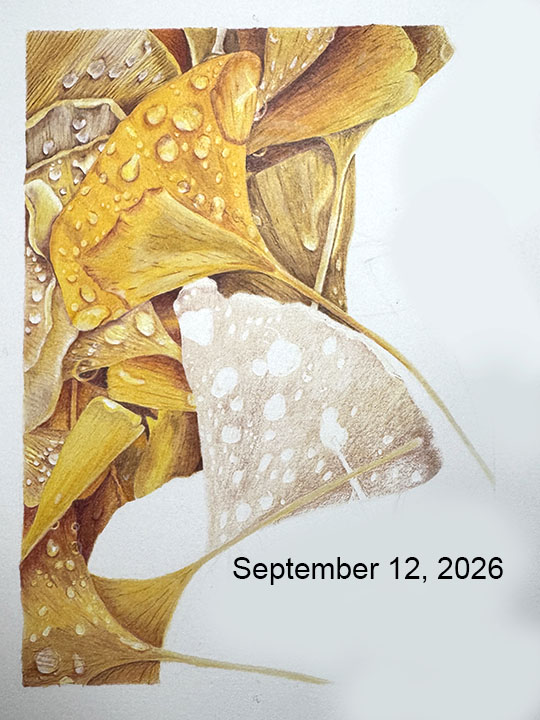
In-progress picture of my ginkgo leaves.
The unfinished portion has been blurred. No peeking ahead!
The Star of the Show
On the easel is a study of ginkgo leaves covered in raindrops.
The Supporting Cast
The paper:
- Legion Stonehenge White paper
- The finished drawing will be 7 in. x 5 in.
The pencils:
- Caran d'Ache Luminance
- Faber-Castell Polychromos
- Derwent Lightfast
The Production Specifics
There are a surprising number of pencils being utilized in this work, including pale peaches, beiges, cinnamons, russets, yellows, oranges, reds and browns. The piece is half-finished, and each leaf's color combination has been unique.
This was intended to be a study for a larger piece (do I reeeally want to draw the whole 20" x 16" version??), but a fellow artist suggested making it one panel of a triptych instead. Hmm....
❀ ❀ ❀ ❀ ❀
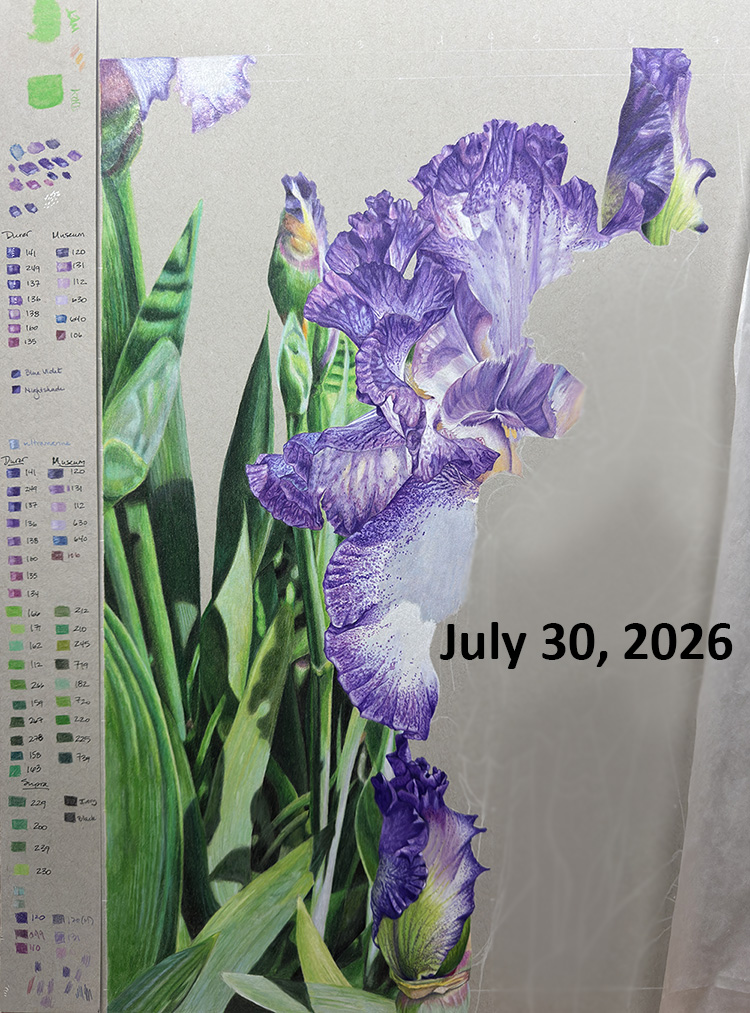
In-progress picture of my iris project.
On the left is my test swatch. Working on tinted paper means that colors don't always appear as expected; this is one way to confirm.
And, yes, the unfinished portion has been blurred. No peeking ahead!
The Star of the Show
On the easel is a Rococo iris.
The Supporting Cast
The paper:
- Strathmore Toned Gray Mixed Media paper
- The finished drawing will be 18.5 in. x 15 in.
The watercolour pencils:
- Caran d'Ache Museum Aquarelle
- Caran d'Ache Supracolor II Soft
- Faber-Castell Albrecht Dūrer Watercolour Pencils
The Production Specifics
There are a lot of pencils being utilized in this work. The particular shade of bluish-purple, the yellow of the iris's throat, plus the leaves and buds, mean that there are 55 pencils in active use (plus 20 additional "maybes" on standby) to realistically render all the colors as they play in sunlight and shadow. It's a fun but very time-consuming challenge… just the way I like it!
Previously, I have used watercolour pencils strictly in their dry state (Pumpkin Indecision and Irish Coffee are two examples). This time I am opting to activate the base layer with water, as the pencils are designed to be used. Many of the colors change dramatically when water is applied. At the risk of compromising the paper, I will not rewet a section more than once. When dry, the water-activated layer is always covered by additional dry pencil layers; sometimes 7-9 additional layers of color are applied over the base layer to achieve the final image.