
Scribbles : My Blog
Watercolour Pencils: What I wish I had known…
Color pencils come in many colors, qualities, and formulations. They share common traits: all contain a mixture of pigments and binders of oils and/or waxes in varying percentages. With the application of a solvent such as odorless mineral spirits or rubbing alcohol, the binders holding the pigments together are chemically dissolved, to a wide range of effects. These binders, however, cannot be dissolved with water; oil/wax and water don't mix.
Enter the watercolour pencil.
In 1931, Swiss company Caran d'Ache developed the first pencil with a water-soluble binder, Prismalo Aquarelle. These pencils opened a cornucopia of possibilities. No more paint tubes to carry around; all an artist needed was a sharp knife to remove the wood surrounding the pencil's core, a selection of bushes, and of course, water. They could be applied and kept dry on the paper, or wetted for a painterly look.
Prismalo Aquarelles are still manufactured and were my very first set of color pencils. I still have them. Sadly, 7-year-old me thought they would render the magnificent, richly-colored image of the Matterhorn that graces the tin, which turns out is a photograph. I remember trying to activate them with water, which just produced a sloppy mess on the thin copy paper on which I'd drawn my masterpiece. That's probably why most of them are still nearly unused (and I'm a bit sentimental about them now).
I stumbled upon Caran d'Ache's Museum Aquarelle Watercolour and Supracolor Soft pencils shortly after restarting my color pencil odyssey a few years ago. Based on my childhood experience, I worked with them only in their dry state, creating my award-winning works Pumpkin Indecision and Irish Coffee. I love how they feel when they connect with the paper, the effortless blending just by adding layer after layer or by applying a bit more pressure onto the paper as I color. They have become my go-to favorites. However, that was just the intro to their whole story….
I have had a lifelong ambivalence towards watercolour art. In my experience, the works are usually abstract, blurry images whose colors are muddy, muted and as lifeless as a graveyard on a wet Sunday. As hard as I try, I cannot fathom that most of the works I've seen took more than a few minutes to render.
Then I discovered the creations of watercolour artist Billy Showell. My entire perspective morphed before my unbelieving eyes. Seeing her artwork was like throwing blackout curtains open on a warm, sunlit spring morning; I swear I even heard birds singing. Brilliant, vibrant, intoxicating colors that pull the viewer in. Brown, earthy shades that hum with life. Flowers rendered so meticulously and lovingly you want to pluck them off the page and drop them in a vase. Details so finely wrought I needed my magnifying glass to fully appreciate them. This was watercolour?? I had to be part of it.
Turns out that, among her many secrets, Billy starts with the highest-quality paints. I eyed my Museum Aquarelles, perhaps the highest quality watercolour pencils on the market. What would happen if I used them the way they were designed? So, I squiggled a bit of yellow on a piece of paper, dipped a brush in water, and ran the brush over the pencil mark. The yellow, beautiful in its own right when dry, positively glowed when wetted. It faded slightly as it dried, as all watercolour does, but still retained its cheery personality. Hmmmm….
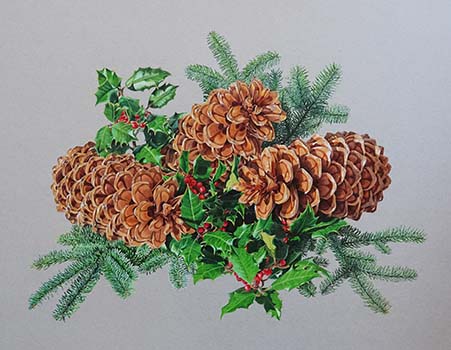
I deliberately chose a heavier mixed media paper when beginning my 2025 Christmas card. The subject is a complicated blend of holly and pine greens, with scarlety-red holly berries, and three pinecones at various angles to the light. It's also huge by color pencil standards - 16 in. x 20 in. (40 cm x 51 cm) - and this was the beginning of November. Nothing ventured, nothing gained, and no room for do-overs. With the Museum Aquarelles and Supracolors in hand I dove in. Working in small sections, I applied several layers of color, used a brush and water to bring them to life, let the paper dry, then added more layers of dry pencil over the water-activated base layer. It made all the difference to the vibrancy of the piece. The end result assures that this is the technique I will use moving forward. I've already altered my methods mid-process on my current piece, the Rococo iris.
But that's not all these little gems can do. Using a wet brush, you can pick up color directly from the pencil, and apply it to the paper. Think delicate fluff on a willow catkin, tiny glimmers of sunlight on the surface of water… or freckles on my iris. Or, go bold or go home: dip the pencil 'lead' itself in water, and then draw directly on the paper for a gob-smacking splash of color.
Caran d'Ache also makes a special little palette for watercolour pencils. Scribble a bit on the palette then add a few drops of water, and voila: watercolour paint! Why the palette? You need some tooth for the pencils to grab onto (unlike smooth acrylic, porcelain or metal palettes) and a surface impervious to water (unlike paper) to be able to load the color into your brush. This paint can then be used with traditional watercolour painting techniques. Who knew? Not many, if the Internet is to be believed. That palette may just be Caran d'Ache's best kept secret.
The stunning Faber-Castell Albrecht Dürer Watercolour Pencils have been added to my collection over the past year. I am so grateful to have found this medium, as I discover new ways to use them every single time they find their way into my hands.
I also thank Billy Showell for opening my eyes afresh to the world of watercolour. Her lovely instructional videos are delightful to watch, and her mesmerizing botanical art brings light to the world with every stroke of her brush. We work in different mediums, but we aspire to the same goal: to create works that bring people joy.
May we all color the world with peace.
❀ ❀ ❀ ❀ ❀
Originally posted: January 2026
Previous blog: Words to Live By
Find more of Kiki's blogs at The Gratitude Sailing Institute.